
What Are Gummy Molds for Candy and Vitamin Deposit?
A gummy mold is a cavity a depositor fills, a gel sets in, and a dump station empties. Starch moguls, RTV trays, and rigid plastic are not the same tool.
 Kyler Yang · Founder9 min read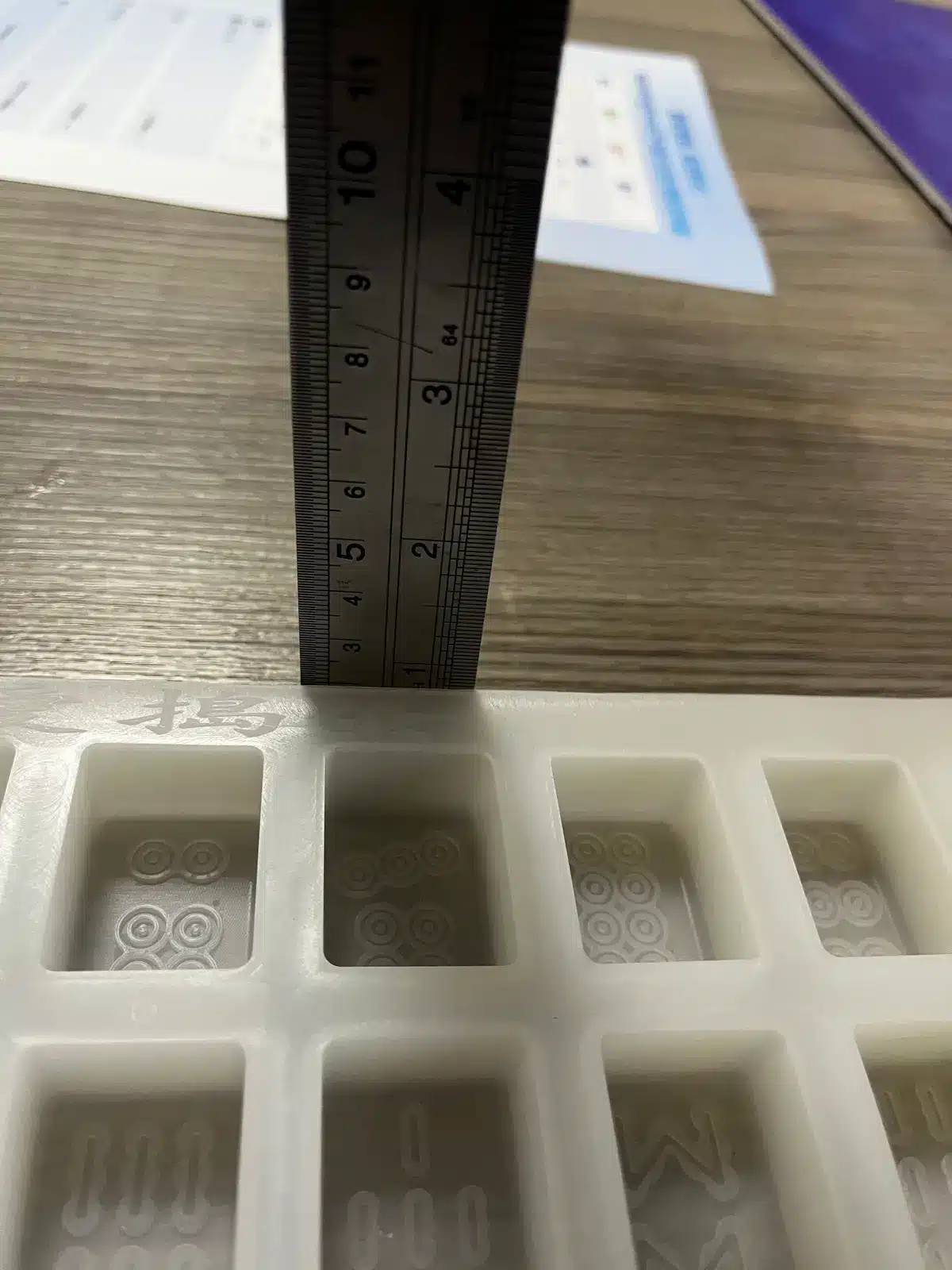
If you are shopping gummy molds, you are usually shopping a cavity: something a depositor can fill to a target volume, a gel can set in, and a dump station can empty without tearing ears or smearing a logo. The recipe is not the mold. Gelatin, pectin, acids, colors, and any vitamin load stay with the candy or nutraceutical plant. Search results mix kitchen hearts, starch mogul starch, polycarbonate cups, and platinum RTV trays, and those are not synonyms.
On this site the path is photos, sketch, or CAD, then a 3D-printed pattern, often a temporary silicone flip, a resin production mother, then batch RTV. The mother is not the pattern. Free DFM. HTV/HCR compression mold tooling is also quoted on RUUIPON.
The object on this page
Call it a mold, a tray, a plate, a mogul board, or a depositing tool. The functional unit is one cavity with a known volume, a fill face the head can hit, walls the slurry will wet, and a release path the set gel can take. Piece weight on a vitamin line is mostly that volume plus slurry density and fill height. Kitchen language (bear mold, heart mold) is a shape nickname. Plant language is millilitres, array pitch, tray envelope, dump method, and wash temperature.
Classic candy bears at volume often never see silicone. A starch mogul prints a negative in dry starch. Reusable trays show up when starch dust is not welcome, when logos and undercuts need a sharp rubber face, when the run is short, or when the line already registers a plate. Polycarbonate owns simple, drafted cups. Platinum RTV earns the tray when you need flex dump, a peelable undercut, or a rubber face in a jacket / mother-mold support shell. Kitchen one-ups are a fourth SKU: hand fill, hand peel, useless as a servo plate. If your email still says "master, box, keys, jacket" as the buy, you are listing shop furniture, not the object.
Deposit: a servo or piston head places a shot. Deep ears and letter counters starve if the slurry is viscous and the blob lands in the belly. Set: gelatin and pectin set on time and temperature, not on Shore A. A floppy kitchen sheet will not sit flat on a cooling belt. Dump: invert-and-knock, flex over a roller, or peel a one-up by hand. Oil is a plant decision; it is not a substitute for geometry.
Common mix-up
A lot of RFQs treat a kitchen heart mold as a 4x10 depositing tray. In the shop that usually means you have sent envelope-free artwork and we will stop you before we pour a floppy one-up that misses every pin. Retail trays lack depositor pitch, locating, a dump motion other than peel, article identity after post-cure, and a spare fleet. Catalog copy that says cut a resin master skips the pattern-vs-mother split. We will not quote that sentence.
Typical shop values
Reference values only. Confirm material-specific limits against the supplier’s technical data and agree project acceptance criteria before production.
| Item | Typical shop value |
|---|---|
| Path (RTV tray) | Photos / sketch / CAD, 3D-printed pattern, often a flip, resin production mother, batch RTV |
| Piece-weight target | 4.0 g (cavity volume x measured slurry density; fill-to-brim or fill-to-line stated) |
| Outer-row vs center | 3-6% heavy if the loaded tray sags under the nozzles |
| Loaded-tray edge sag | 0.5-1.5 mm without a flat support shell |
| Cavity Shore | 10A-20A platinum RTV skin + jacket / mother-mold support shell |
| Platinum linear shrink | 0.1-0.3% (compensate on the pattern and living mother) |
| Mix | Platinum 1:1 or 10:1; vacuum degas until foam collapses |
| DFM / CAD / proto / MOQ | Free DFM; USD 50 when we edit 3D; 3-7 days after CAD lock; 20 pcs/design |
Worked example
A first production tray on this route is often a 4x8 platinum RTV array, 32 cavities at about 2.2 ml, 16 mm dump depth, Shore 10A-20A face in a resin or aluminum support shell, built for a few thousand dumps a month on a servo head that already has pins. The mascot lives in the living mother. The support shell is what keeps pitch when the belt moves. After CAD lock: pattern, often a flip, mother, batch RTV.
Stay on this page / skip this page
Stay when you need the noun defined: starch vs PC vs platinum RTV tray vs kitchen one-up.
Skip if you actually need a starch mogul stamp - hire a mogul OEM. Skip thousands of vulcanized silicone parts - a different RFQ - ask us. Skip if you already know you need the tray manufacturing sequence - gummy mold manufacturing. A kitchen one-up you will peel by hand can skip the support shell and the pin pattern; a servo head cannot.
We will not treat a kitchen heart as a line plate. We will not raise Shore A first to make it stand up under a servo head - add the support shell and copy nozzle pitch. We will not cut an LSR cold-runner tool so you own steel later while the line still dumps pectin. We will not freeze a mascot outline before millilitres. We will not cut a resin master as the written shop path.
Related: gummy trays, manufacturing, food-grade molds, contact.
What to send
- Forming system: starch / PC / platinum RTV tray / kitchen one-up
- Target piece grams (or ml + density) and fill-to-brim vs fill-to-line
- Slurry family: gelatin, pectin, high acid - as fill/dump constraints, not as a recipe ask
- Nozzle pitch, pin pattern, and tray envelope (or bench pipette, no depositor yet)
- Dump method: invert, flex roller, peel
- Food-contact path: 21 CFR 177.2600 and/or LFGB sections 30/31 - not FDA approved
Send the pack to [email protected] or contact.
- What object is the RFQ? - PC cup, knock dump -> Rigid plastic plate
- What object is the RFQ? - flex dump / undercut / no dust -> Jacketed platinum RTV: pattern, often flip, mother, batch RTV
- What object is the RFQ? - kitchen one-up -> Bench peel only - not a servo plate
- Jacketed platinum RTV: pattern, often flip, mother, batch RTV -> Freeze volume + pitch
FAQ
Is a starch mogul a gummy mold? Yes in the plant sense: the starch impression is the cavity the depositor fills. It is not a reusable platinum RTV tray and it is not a 21 CFR 177.2600 rubber article.
Does the gummy recipe change what the mold is? The recipe changes viscosity, set time, and how the piece releases. The mold is still a cavity with a volume, pitch, and dump path. Send slurry behavior as fill and dump constraints, not as a request to formulate vitamins.
Are silicone baking molds the same as gummy trays? No. A muffin cup is oven geometry. A gummy tray is a depositor target with a dump station and a piece-weight volume. Food-contact chemistry can overlap. Register, stiffness, and fill rules do not.
Can I use a kitchen heart tray on a servo depositor? Almost never. Soft one-ups flop, miss pitch, and tear. Prototype the shape in a one-up if you must; production is a jacketed RTV tray that copies the line envelope.
Who is the article for 177.2600 and LFGB on a silicone gummy tray? The poured, post-cured tray you will wash and fill, not a generic plaque and not the gummy itself. 21 CFR 177.2600 is extractives on that rubber article after cleansing, not an FDA approved stamp.
Custom silicone development · DFM & prototype support
CAD, drawing, photos or sample details