
Minimum Feature Size on a Resin RTV Master | RUUIPON
Print resolution and rubber fill set minimum logo depth and serif width. Stair-steps become cavities. Typical shop values. MOQ 20 pcs, $50 CAD.
 Kyler Yang · Founder9 min read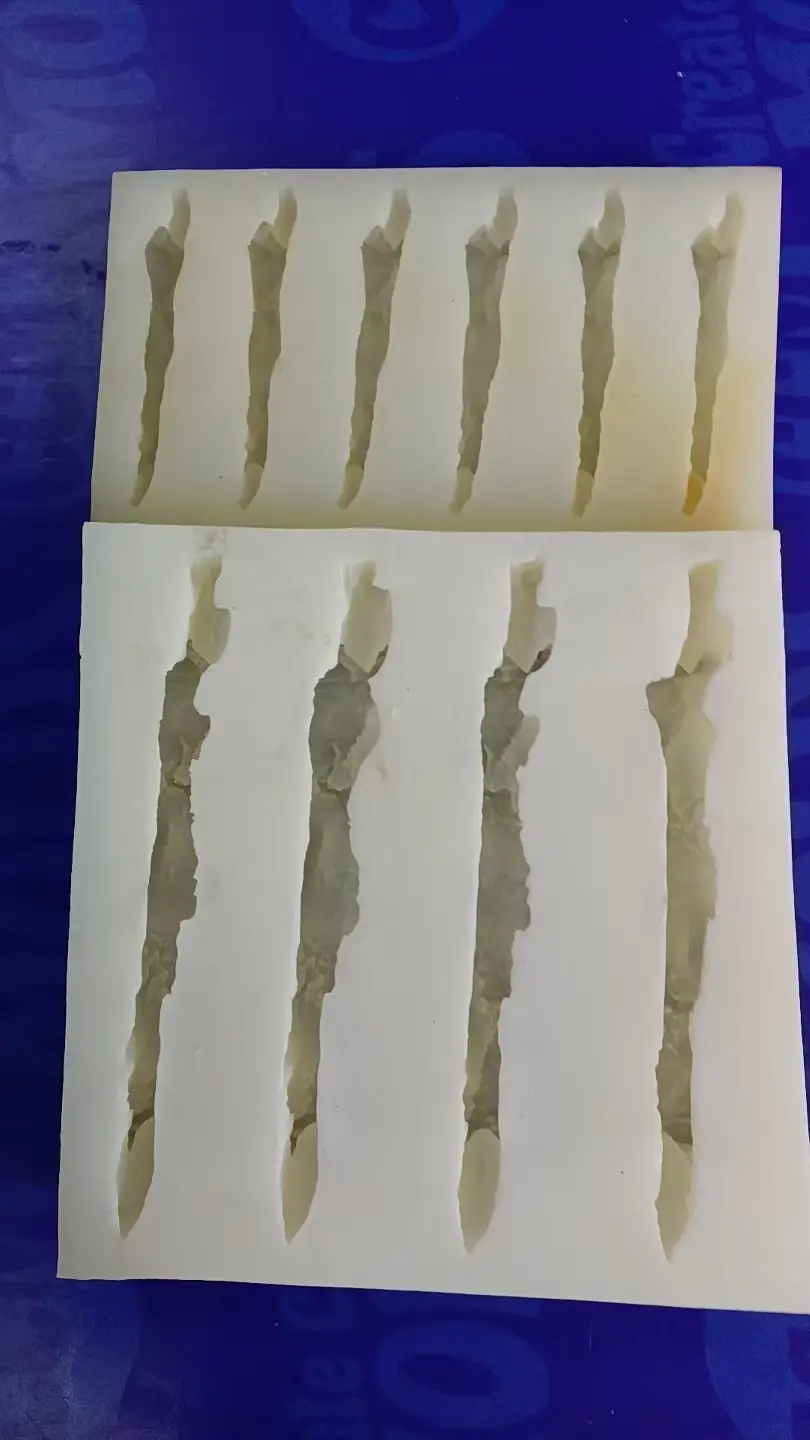
A resin master can show a serif the SLA machine advertised, and the platinum still will not copy it. Minimum feature is the coarsest of three gates: what the print actually resolved, what the mixed RTV will fill under vacuum, and what the dump (resin, plaster, chocolate, PU) will fill on the way back out. If you send a 0.15 mm hairline and ask for a 20A block, the rubber bridges the valley. The dump then copies a smear. We lock a feature size on the master drawing before CAD lock, not on the printer brochure. Wash, UV, and seal still apply; they do not make a vanished serif reappear.
RUUIPON pours around resin masters in Bao'an, Xinhe Blvd, Shajing, since 2018. Mix is 1:1 or 10:1 by weight. Prototype is 3–7 business days after CAD lock of that feature, not after the STL left the laptop. Production is MOQ 20 pieces per design. Simple 3D is USD $50 when that CAD scope applies. Platinum shrink after a full cure is typically about 0.1–0.3%. Print-as-master sequence: 3D-printed master. Steel/LSR *parts*: an HTV product RFQ here.
Does not apply when the master is CNC metal with a cut depth we can measure, when the "feature" is a texture catalog on a steel insert, or when you only needed a chunky open-back magnet. Food dumps still need a sealed, slugged print — a tiny logo does not skip that. No grease on a food well; no tin under chocolate.
Print resolved it; rubber still has to enter the valley
SLA/DLP can hold a raised rib that FDM will never see. That rib still has to wet with platinum that is already climbing in viscosity as pot life runs. A 10A skin fills a tighter valley than a 30A tray rubber, and a detail coat (thixo brush) fills better than a single block pour. Vacuum helps the well; it does not invent wet-out if the valley is a knife slot.
The dump is the third gate. UV resin with a surface-tension skin will skip a 0.2 mm pip that plaster would take. Chocolate will skip a sharp inside corner you thought was "minimum feature." Name the dump on the RFQ or we size the master for the wrong chemistry.
The RUUIPON Mold Structure Decision still runs: flat back → open-back; peelable undercuts → glove; if not → split/plug/core. A hair-width undercut that the print resolved is often a tear, not a feature. We would not keep a 0.2 mm hook "because the SLA showed it."
- Print actually resolved it? - no -> Thicken or $50 CAD cleanup
- Print actually resolved it? - yes -> Will this Shore RTV fill the valley?
- Will this Shore RTV fill the valley? - no -> Detail coat, lower Shore, or enlarge
- Will this Shore RTV fill the valley? - yes -> Will this dump fill on the way out?
- Will this dump fill on the way out? - no -> Change dump or change the feature
- Will this dump fill on the way out? - yes -> CAD lock, then 3-7 business days
- Thicken or $50 CAD cleanup -> CAD lock, then 3-7 business days
- Detail coat, lower Shore, or enlarge -> CAD lock, then 3-7 business days
- Change dump or change the feature -> CAD lock, then 3-7 business days
The photo that would prove a min-feature call: millimetre scale on the master rib, the open cavity copying it, and the first dump. A printer screenshot of layer height is not that photo.
ISO 3302-1 M2 is a size class on the dump. It does not mean "every serif survived." Write critical stroke millimetres as notes.
Typical shop talk we will actually have: raised-on-master ribs often need to be thicker than the brochure XY; recessed letters need draft plus a floor the rubber can leave. Layer lines on FDM are a texture, not a feature you can dimension.
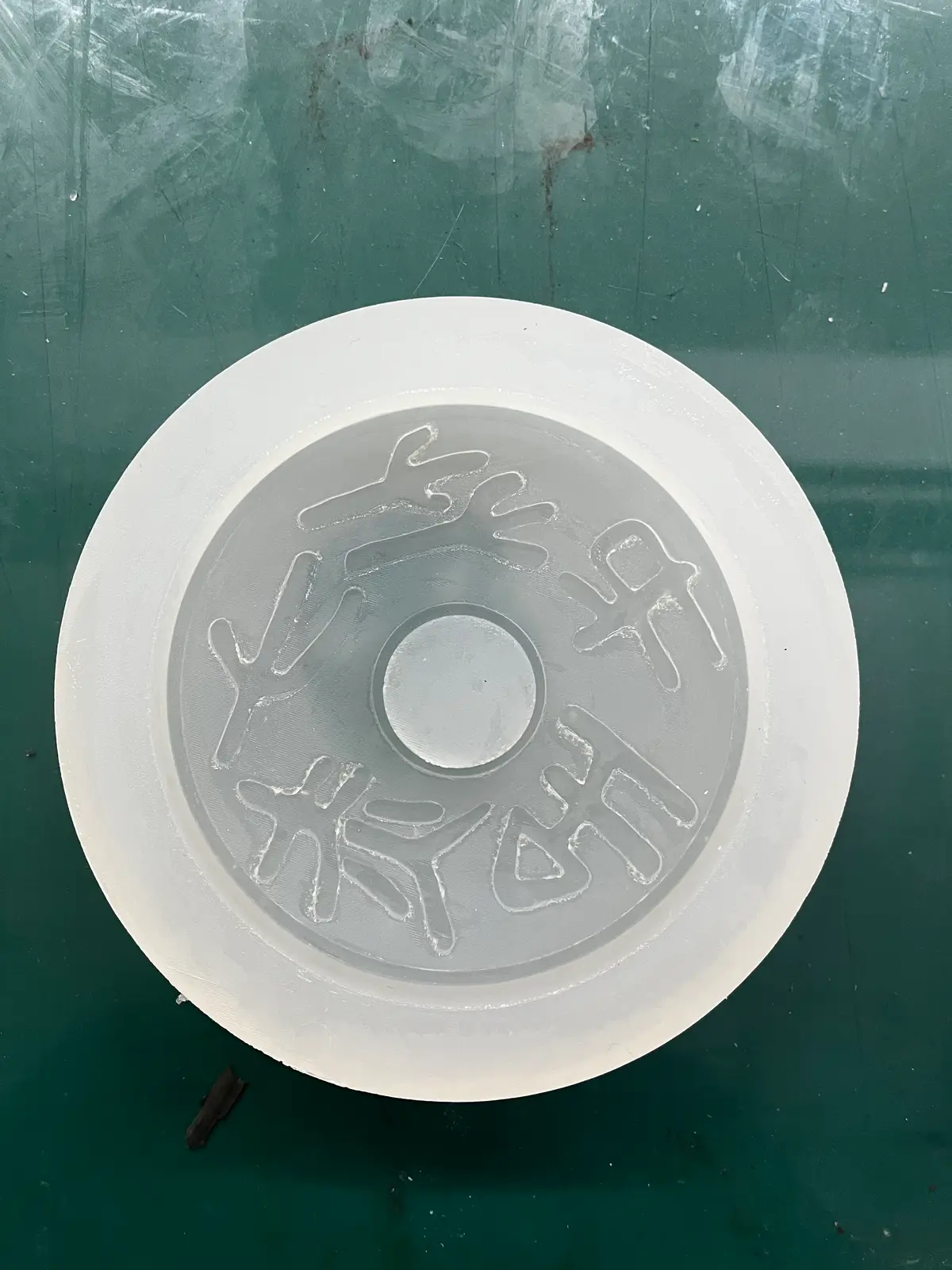
Failure: logo filled in CAD, smear in 20A
Symptom: witness dump shows a blob where the serif should split; or a pip that is a hill instead of a point.
Cause: valley narrower than this rubber will enter; detail coat skipped; dump surface tension; unsealed SLA inhibition that ate the face before fill mattered.
Confirm: caliper or loupe on the master, then on the cavity, then on the dump. If the master still has the rib and the cavity does not, it is rubber fill. If the cavity has it and the dump does not, it is dump fill.
Fix: enlarge the feature, drop to a 10A–20A skin with a detail coat, or change dump. Do not raise Shore as the first move — a 40A brick fills worse. Do not "just scale 12%." Loaded sag of about 0.5–1.5 mm is jacket work after the feature exists.
Typical shop values
Reference values only. Confirm material-specific limits against the supplier’s technical data and agree project acceptance criteria before production.
| Item | Typical shop value |
|---|---|
| Mix / shrink | 1:1 or 10:1 by weight; platinum about 0.1–0.3% |
| Cavity Shore | 10A–20A skins copy tighter valleys; 20A–40A trays need larger features |
| Print start | SLA/DLP for logos; FDM only after sand/seal |
| Critical stroke | write millimetres on the drawing; do not cite brochure XY |
| Loaded sag without jacket | about 0.5–1.5 mm |
| Prototype | 3–7 business days after CAD lock |
| Production MOQ | 20 pieces per design |
| Simple 3D | USD $50 when that CAD scope applies |
| Drawing class | ISO 3302-1 M2 as a common default |
Features we would not promise from an SLA
We would not recommend a 0.1 mm hairline as a production CTQ on a 20A block pour.
We would not recommend trusting FDM nozzle width as the cavity spec. Sand, fill, seal, then measure the master you will actually pour around.
We would not recommend a food-logo recast from an unsealed print because "the serif is small so inhibition will be small." Inhibition is chemistry, not size. Slug it.
We would not recommend copying a competitor's micro-texture from a photo. We need your art. See copying a competitor when that page is live.
A tooling charge is not unrestricted ownership of the cleaned CAD. Recasts follow the locked stroke width unless you pay to change it.
Worked example: 0.3 mm serif, 28 mm pendant, 20A block
Jewelry resin pendant, 28 mm, SLA master with a 0.3 mm raised serif on the name. Buyer poured a 20A block in one shot, no detail coat. Cavity showed a fused valley; UV dump copied a smear. Recast: $50 CAD applied to thicken the stroke to a lockable millimetre, wash/UV/seal the new print, 10A detail coat then 20A jacket. Prototype 3–7 business days after that CAD lock. Production MOQ 20 of that design. Related: jewelry resin molds.
SLA drain holes in a closed serif leave a pit the dump will copy. Vent the letter in CAD or fill the hole before seal. FDM stringing across a well becomes a hair in chocolate. Clip strings before platinum.
We would not promise a 0.2 mm food logo from a marketplace FDM print and a $50 CAD that is only a scale fix. If the letter is the SKU, budget a real master. If the letter is a tiny on-back mark, maybe skip it and pad-print the dump instead — that is a different factory object.
Pin gates and vent nubs on the master are not dump gates. Do not confuse a 0.5 mm master vent with a steel LSR gate vestige. Wrong chemistry, wrong shop.
Jacket still if loaded. Min feature is the letter. Sag is the sheet. Both can be wrong on the same PO. Prototype 3–7 business days after CAD lock, MOQ 20 per design, USD $50 CAD when that scope applies, mix 1:1 or 10:1, shrink about 0.1–0.3%, ISO 3302-1 M2 as a common dump class.
Mix-up: printer resolution is the mold spec
Layer height is a print setting. Rubber fill is viscosity, Shore, vacuum, and whether you brushed a detail coat. Dump fill is a third chemistry. The other mix-up is calling a stair-step a feature you wanted. We sand or we keep it as texture — you choose before lock.
What to ask when you're buying the master
- Critical stroke millimetres, raised or recessed on the dump?
- Print process (SLA/DLP vs FDM) and a sealed witness?
- Shore and whether a detail coat is in the pour plan?
- Dump chemistry — resin, PU, plaster, chocolate (platinum, no tin, no grease)?
- After CAD lock, 3–7 business days, then MOQ 20 / design?
Related: FDM PLA master, contact.
RFQ copy-pack — min feature on the master
Paste into [email protected]:
Object: RTV mold I pour into, not an LSR/HCR part Master: SLA / DLP / FDM / CNC, sealed yes/no Critical features: stroke mm, raised or recessed on dump Dump: resin / PU / plaster / chocolate (no tin, no grease) Shore target or ask us Detail coat: yes / ask us File: STEP / STL / photos with a millimetre scale CAD: mold-ready STEP OR USD $50 3D if that scope applies Prototype 3–7 business days after CAD lock, then MOQ 20 per design
Send the stroke millimetres you will reject on, not "high resolution." We lock the feature — not a blank free quote. Phone +86 135 3006 2969. Licheng Technology Industry Park, Xinhe Blvd, Shajing, Bao'an. Shop since 2018.
FAQ
Will platinum copy every line my SLA printed? Only if the rubber fills the valley and the dump fills on the way out. Brochure XY is not a cavity promise.
Should I raise Shore so tiny logos last longer? Usually the opposite. A harder pour fills a tight valley worse. Jacket for life; Shore for peel and fill.
Is a 0.2 mm pip a fair CTQ on a dice or pendant? Call it on the drawing and expect a conversation. We may thicken it, add a detail coat, or refuse it as a production CTQ.
Does sealing the print shrink the feature? A heavy coat can bury a serif. Seal thin, then measure the master you will pour around.
Does changing the serif restart the 3–7 day clock? Yes. CAD lock includes the locked stroke. A thickened logo is a new lock. MOQ 20 per design after the witness.
Custom silicone development · DFM & prototype support
CAD, drawing, photos or sample details