
Why Cavity Count Matters for an RTV Tray | RUUIPON
More pockets mean more platinum, thinner webs, and edge sag. Count is a layout bet against grams — not Baker Perkins pitch or shift output at all.
 Kyler Yang · Founder7 min read
Cavity count on a custom platinum tray is how much rubber you buy, how thin the webs get, and whether a loaded sheet sags about 0.5–1.5 mm at the edge. Extra pockets look like free output. They are extra A/B, a larger jacket, and outer-row grams that often run 3–6% heavy versus the center when the sheet droops. This is not a depositor-pitch article. Nozzle maps, Baker Perkins spacing, and “how many cavities per shift” belong on a steel/depositor job at wydsilicone.com. Here we decide how many wells a platinum skin and a rigid jacket can hold without the dump drifting.
RUUIPON, Bao'an since 2018. Prototype 3–7 business days after CAD lock. MOQ 20 pieces per design — a 48-up and a 12-up are two designs if the layout changed. USD $50 when CAD scope applies.
Does not apply when you already have a nozzle coordinate drawing, when the object is a one-cavity resin figurine (structure, not sheet layout), or when you need a mogul starch tray. Send those packs elsewhere.
What extra cavities actually cost you
Rubber volume. Each well is a hole in the master and a wall of platinum around it. Count goes up, mix goes up, vacuum cup goes up. A “just add eight more” email is a new volume calc, not a free CAD tweak.
Webs. Thin lands between pockets tear on invert and let dumps talk to each other. Thick lands waste count for stiffness you could have put in a jacket.
Jacket and sag. Deep pockets on a large sheet are a sag machine. Raising Shore A to stiffen a lace-thin 48-up is the wrong first lever. Cut count or thicken the jacket.
Family layouts. Two geometries on one sheet only if Shore, shrink (platinum about 0.1–0.3%), and dump cycle match. A shallow logo tile next to a deep mascot is not a save.
MOQ. 20 pieces per design. Doubling count on the same SKU to “make MOQ feel smaller” still pours 20 of that layout. Piece economics change; the twenty does not vanish.
ISO 3302-1 M2 on the tray drawing does not make sixteen pockets weigh the same.
Typical shop values
Caption: Typical shop values.
| Item | Typical shop value |
|---|---|
| Cavity Shore | 10A–20A skin with jacket; 20A–40A on some food trays |
| Loaded-tray edge sag | about 0.5–1.5 mm when the jacket is weak |
| Outer-row gummies vs center | often 3–6% heavy when sag is in play |
| Platinum shrink | about 0.1–0.3% |
| Mix | 1:1 or 10:1 by weight, vacuum |
| Prototype | 3–7 business days after CAD lock |
| MOQ | 20 pieces per design |
| Simple 3D | USD $50 when CAD scope applies |
The photo that would prove a count call: loaded tray on a plate with a straightedge at the edge, then a weigh sheet of every pocket, center versus outer row.
Worked example (anonymized)
A buyer wanted 48 pectin wells on a half-sheet “because the copacker’s other tray is 48.” No nozzle map — they were hand-pipetting. First CAD at 48-up, 20A, no jacket, sagged. Outer row ran heavy. We cut to 24-up, added a jacket, same well millimetres. $50 because the layout was rebuilt. Lock, 3–7 business days, MOQ 20 of the 24-up. The 48 was a copacker memory, not a rubber layout.
Rubber volume is an RFQ field, not a surprise on the invoice
We estimate mix from box envelope minus master volume plus waste for the cup, brush coat, and a leftover puck. Count changes the hole map inside that envelope. A 12-up and a 36-up in the same outer tray size are not the same kilograms of platinum. If you do not send overalls, we cannot pretend we know the cup.
Hand-fill and flood-and-scrape hide different sins. Flood-and-scrape can mask sag until you weigh. A pipette shows underfill immediately. Say which you run. We would not design a 48-up for a pipette user who cannot reach the inner row without dragging a sleeve through wet pectin.
Spare rotation also tracks count. One torn web on a 36-up kills more output than the same nick on a 12-up. If cycle life is the worry, buy rotation qty of a stiffer layout rather than maxing pockets on a singleton skin. Recast from an unsanded master while it still exists.
One procurement mix-up
Copying a depositor cavity count onto an RTV hand-fill tray is how you buy sag. Count is not brand compatibility. Tooling charge ≠ a free add-cavity after you approved a lace-thin sheet.
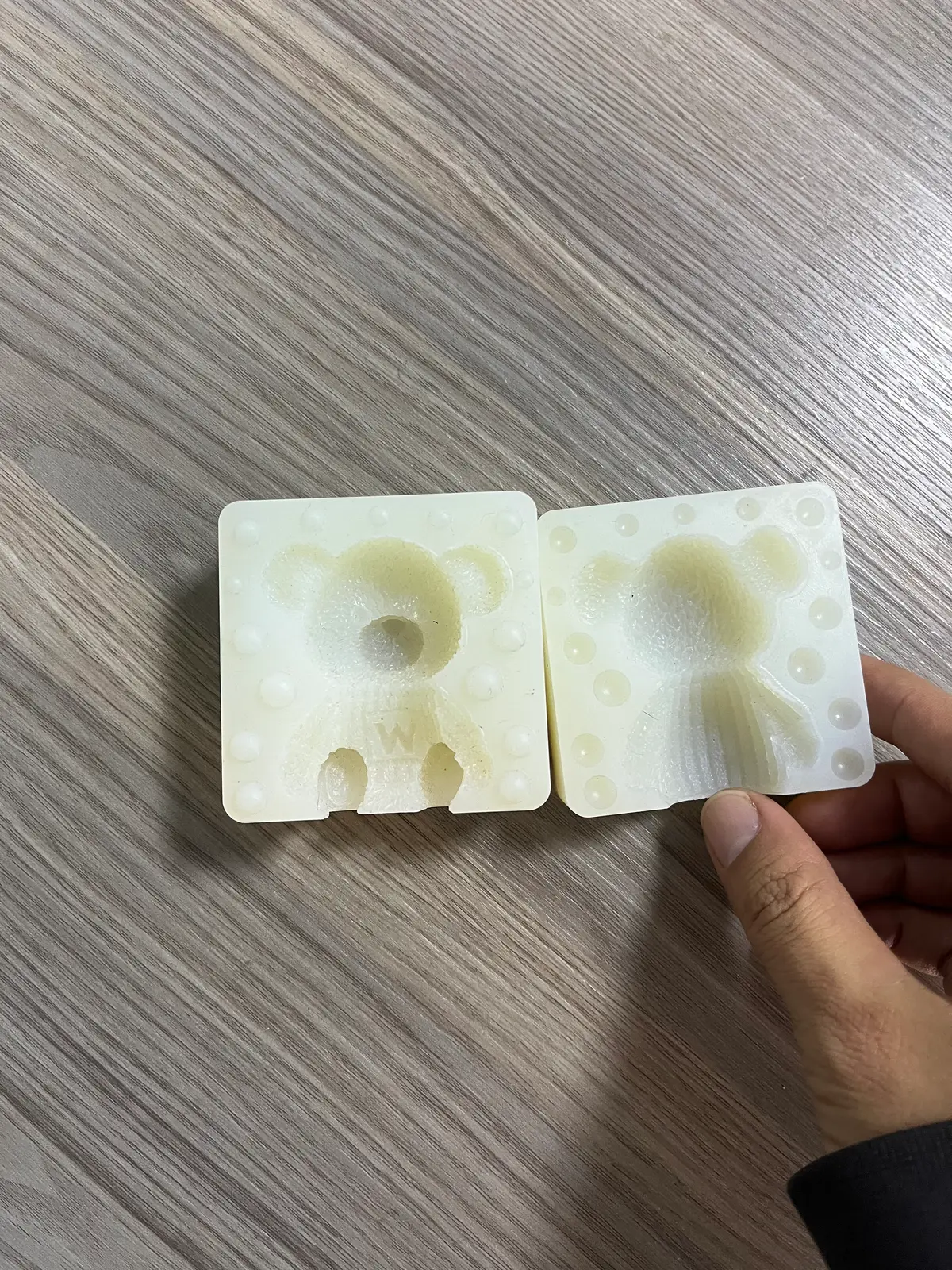
Border rubber is not wasted rubber. A skinny frame curls in a fridge and inverts like a taco. Leave jacket and a real rim so the sheet stays on the bench. Buyers who crop the border to “fit more bears” pay for curl later. That is a count decision wearing a packaging hat.
We would not recommend
We would not recommend adding cavities to dodge MOQ 20.
We would not recommend raising Shore as the first fix for a 48-up that droops.
We would not recommend mixing a shallow tile and a deep mascot on one platinum sheet.
We would not recommend quoting Baker Perkins pitch on ruuipon.com.
flowchart TD
  A[Want more cavities on an RTV tray] --> B{Depositor nozzle map exists?}
  B -->|Yes| C[Wrong site — WYD steel/depositor envelope]
  B -->|No, hand or flood fill| D[Layout vs rubber volume]
  D --> E{Will loaded sheet sag ~0.5–1.5 mm?}
  E -->|Yes| F[Jacket, thicker web, or cut count]
  E -->|No| G[Count can rise if webs still invert-safe]
  F --> H[Lock layout — MOQ 20 of THAT design]
  G --> H
If your copacker named a cavity count, send their nest drawing. A number in an email is not a nest; overalls, well millimetres, and fill method are that nest. We will not reverse-engineer a depositor from a WhatsApp “48” and then argue ISO 3302-1 when grams drift. Send photos of the current tray if you have one.
What to ask when you're buying
- Is count driven by a machine drawing or by a wish?
- Grams CTQ? Then jacket and a weigh sheet, not max count.
- One geometry per sheet?
- If we cut count after sample, is that a new design at MOQ 20?
- Rubber volume: do you want a mix estimate in the RFQ?
RFQ copy-pack
[email protected] · +86 135 3006 2969 · Xinhe Blvd, Shajing, Baoan.
RUUIPON RTV cavity-count RFQ Fill method: hand / flood-scrape / depositor (if depositor, send to WYD) Target count / sheet size Grams or ml per well Jacket allowed? yes/no Dump: gummy / chocolate / resin / other Qty: sample / MOQ 20 of the locked layout CAD: STEP / need $50 3D
Matched next step: send well millimetres, fill method, and whether grams are CTQ. We will push back on a count that sags. Prototype 3–7 business days after CAD lock. MOQ 20 per design.
Related: cavity count vs piece weight, multi-cavity silicone molds, MOQ custom molds, contact.
FAQ
If I add cavities, does piece price drop linearly? No. Rubber, jacket, and sag move. Count is a layout, not a discount coupon.
Can 48-up and 24-up share one MOQ of 20? They are two designs if the layout differs. MOQ 20 pieces per design.
Why not just go harder Shore and keep 48? Harder Shore can lock pectin and still sag if the jacket is the beam you skipped. Jacket first.
Is outer-row heavy a mold defect? Often it is sag of a loaded sheet. Weigh center vs rim before you recast wells.
Does $50 CAD cover a count change after sample? USD $50 when that CAD scope applies. Rebuilding a 48-up into a 24-up is often that scope, not a free tweak.
Ready to order custom silicone molds?
Free quote for OEM/ODM projects. MOQ 20 · Prototype 3-7 days · FDA/LFGB available.